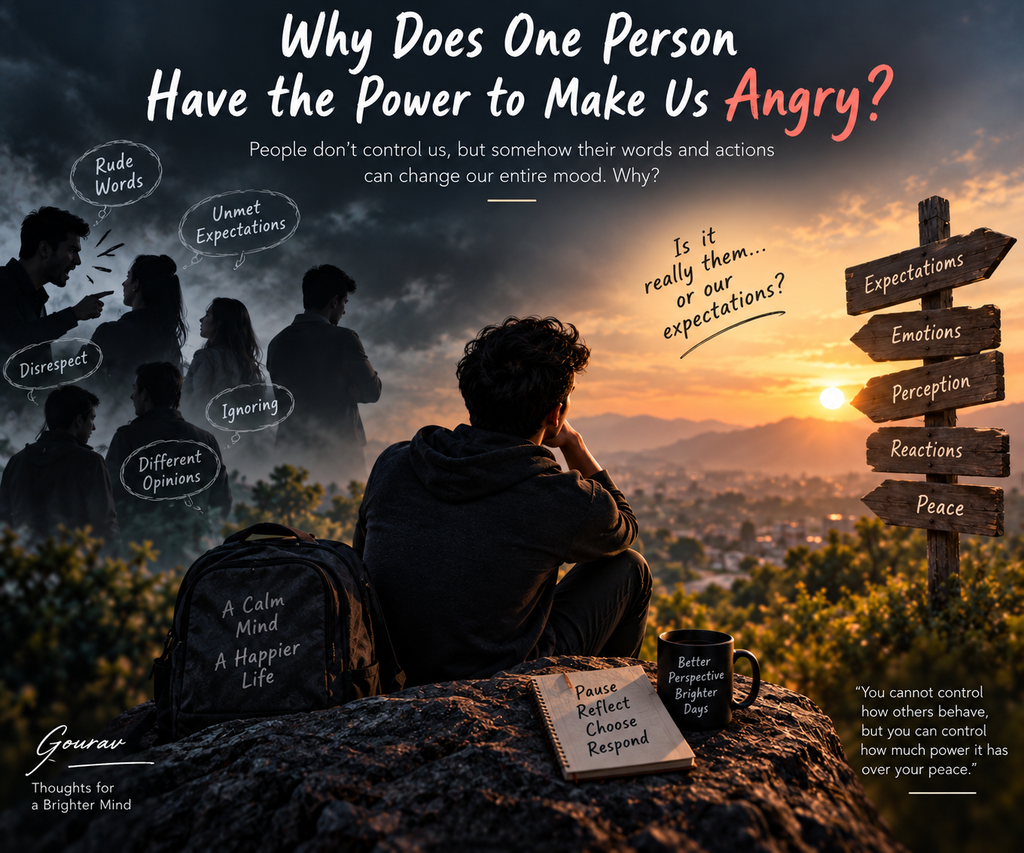
Everyone gets angry.
I don’t think there is a single person on Earth who has never felt anger in their life. Getting angry, becoming irritated, losing our patience, all of these are normal parts of being human.
But sometimes, when I have free time, I start thinking about something else:
Why do we actually get angry?
And more importantly:
How can another person have the power to make us angry?
They don’t physically control us. They don’t have a remote control in their hand.
Yet sometimes, one sentence, one action, or even one person’s behaviour can completely change our mood.
So how does that happen?
When do we usually get angry?
There can be many reasons.
Someone insults us.
Someone speaks to us rudely when we are speaking calmly.
Someone treats us unfairly.
Someone does something that we strongly disagree with.
But I think one reason appears again and again in our everyday life:
Incomplete expectations.
In fact, I feel many of our reasons for getting angry eventually come back to expectations.
We start creating expectations as soon as someone becomes important to us
Whenever someone enters our life and we start getting close to them, we naturally start creating expectations.
And those expectations are different for different relationships.
We expect certain things from our friends.
Different things from our partner.
Different things from our family.
Different things from our employees or colleagues.
And sometimes we don’t even consciously create these expectations. They just develop naturally as the relationship becomes closer.
For example, when you care a lot about someone, you may expect them to care about you in the same way.
If you always make an effort to talk to them, you may expect them to make the same effort.
If you speak respectfully to them, you may expect the same respect in return.
If you are always there for them when they need you, you may expect them to be there when you need them.
And when those expectations aren’t met, something changes inside us.
First, we may feel disappointed.
Then sad.
And sometimes that sadness turns into anger.
The more we give, the more we sometimes expect
This is something I think happens a lot in relationships.
Imagine you are putting a lot of effort into a relationship but feel that the other person isn’t putting in the same effort.
Initially, you may simply feel bad.
Then you start thinking:
“Why am I always the one trying?”
“Don’t they care about me?”
“If I can do this for them, why can’t they do the same for me?”
And slowly, disappointment becomes frustration.
Then frustration becomes anger.
The other person may not even realize how much expectation you have created in your mind.
That’s another interesting part.
Sometimes people are not actually breaking promises. They are simply failing to meet expectations that we created ourselves.
This is where I think we give other people some control over us
Think about it.
If someone’s behaviour can make you extremely happy because they fulfilled your expectations…
And the same person’s behaviour can make you extremely angry because they didn’t fulfil them…
Then haven’t you indirectly given that person some control over your emotions?
They don’t literally control you.
But their actions can control your emotional state.
They can make your day better.
They can ruin your mood.
They can make you feel valued.
They can make you feel ignored.
They can make you feel loved.
And they can make you feel angry.
In that sense, we have given them a certain amount of emotional power over us.
And anger can make us behave differently
This is where things can become dangerous.
When we are calm, we usually know what kind of person we want to be.
We may think:
“I would never intentionally hurt someone.”
But when we are extremely angry, our thinking can change.
We may want revenge.
We may want to hurt the other person in the same way they hurt us.
Someone says something disrespectful, and we want to say something even more disrespectful.
Someone ignores us, and we want to ignore them back.
Someone hurts us, and suddenly our mind says:
“Now I’ll show them how it feels.”
But that’s not necessarily our real nature.
It’s often our anger taking over for that moment.
And later, when we calm down, we may think:
“Why did I react like that?”
That’s one of the strange things about anger.
For a few minutes, it can make us behave like a version of ourselves that we don’t actually want to be.
So how do we reduce this control?
I don’t think the answer is to stop caring about people.
I don’t think we should stop loving people or stop expecting anything from them.
That would be unrealistic.
If you are entering a new relationship, whether it’s friendship, love or marriage, some expectations will naturally develop.
We are human.
The person we love will matter to us, and naturally, their behaviour will affect us.
But perhaps we can reduce our expectations instead of completely depending on them.
Care for someone without keeping a mental scorecard.
Help someone because you want to help them, rather than immediately expecting the same thing in return.
Love someone without expecting them to understand every thought in your mind.
Respect someone without assuming they will always behave exactly as you would.
And most importantly, don’t make your entire happiness dependent on another person’s behaviour.
Maybe the goal isn’t to stop getting angry
I don’t think becoming emotionally mature means never getting angry.
Anger is a natural emotion.
The goal may simply be to stop giving anger complete control over what we do next.
Someone can disappoint us.
Someone can hurt us.
Someone can fail to meet our expectations.
We can feel angry.
That’s normal.
But we still have a choice about what happens after that feeling appears.
We can react immediately.
We can take revenge.
We can say things we don’t mean.
Or we can pause and ask ourselves:
“Is this really worth giving this person control over my peace?”
Sometimes the answer will be yes. There are situations where we should stand up for ourselves and set boundaries.
But many times, we may realize that our anger is coming not only from what the other person did, but also from what we expected them to do.
And perhaps that is something worth thinking about.
We cannot control how other people behave.
But we can slowly learn to control how much power their behaviour has over our happiness, our peace and our actions.
Maybe that’s where emotional freedom actually begins.