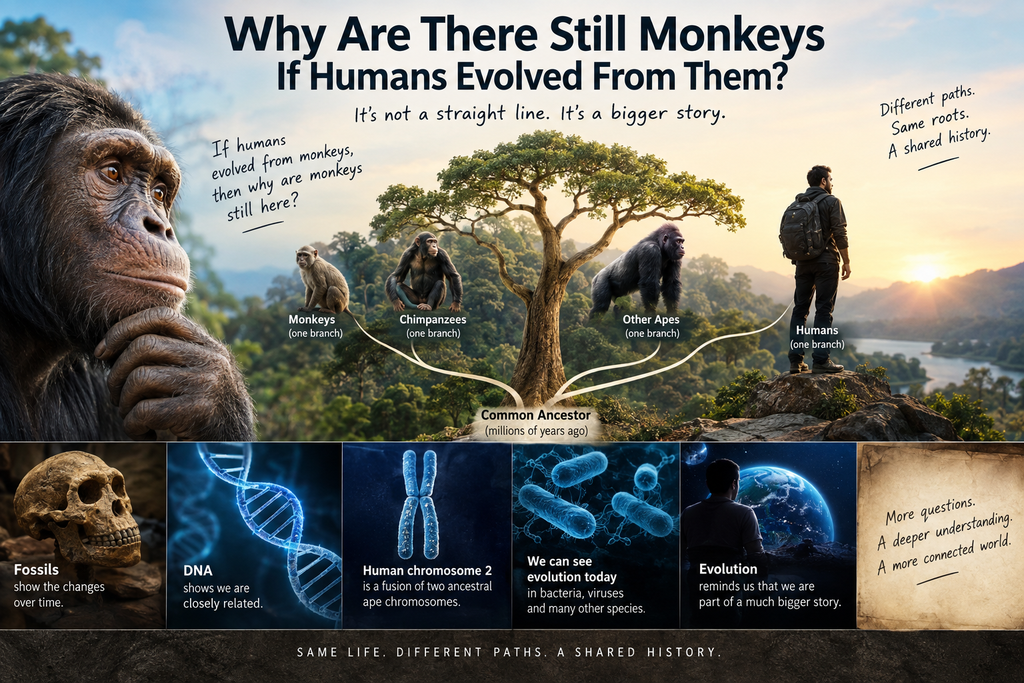
“If humans evolved from monkeys, then why are monkeys still here?”
I have heard this question many times.
And honestly, I think it is a fair question if someone has never properly understood the theory of evolution.
For a long time, I also didn’t understand evolution clearly.
But when I started reading about Darwin, fossils, genetics and how different species are connected, my way of thinking slowly changed.
The theory of evolution became one of the most important scientific ideas in my life. It changed the way I look at humans, animals, nature and even religion.
This was also one of the times when I started respecting science more than religion when it came to understanding how the natural world works.
So let’s start with the most common question.
Did humans really evolve from monkeys?
No.
This is probably the biggest misunderstanding about evolution.
Evolution never says:
Monkey → Ape → Human
It doesn’t work like a straight line.
Evolution is more like a tree.
Imagine a tree. It starts with one trunk and then keeps dividing into different branches. Some branches continue, some divide again, and some eventually disappear.
Evolution works in a similar way.
Humans did not come from the monkeys or chimpanzees that are alive today.
Instead, humans and chimpanzees share a common ancestor that lived millions of years ago.
Scientists estimate that the human line and the chimpanzee and bonobo line separated from a common ancestor roughly 8 to 6 million years ago.
After that, the different groups followed their own evolutionary paths.
One branch eventually led to modern humans.
Other branches eventually led to modern chimpanzees and bonobos.
So when someone asks:
“If humans came from monkeys, why are monkeys still here?”
the simple answer is:
We didn’t come from the monkeys we see today. We share an older ancestor with them.
It’s similar to having a cousin.
You and your cousin don’t come from each other. You both come from a common family line.
So what exactly is evolution?
Evolution is not one animal suddenly turning into another animal.
It is a very slow change that happens in populations over many generations.
Every population has differences between individuals.
Some of these differences can help an organism survive better in its environment.
If those differences can be passed to the next generation, they can become more common over many generations.
At the same time, different groups of the same species can become separated because of geography, environment or other reasons.
Over a very long period of time, these differences can become large enough that new species develop.
And not every branch survives.
Some species become extinct.
This is why the evolutionary tree has both living branches and branches that ended millions of years ago.
Human evolution itself wasn’t a simple straight line either. There were many different human relatives and species in the past. Some lived at the same time as each other, and many eventually became extinct.
Darwin had an incredible idea
Charles Darwin published On the Origin of Species in 1859.
Darwin was not the first person to suggest that species could change over time.
But his major contribution was explaining how natural selection could cause these changes.
During his famous voyage on HMS Beagle, Darwin observed many plants and animals and noticed how species could be different depending on their environment.
His observations, including his work with birds in the Galápagos Islands, became an important part of his thinking.
What amazes me is what Darwin didn’t have.
He didn’t know about DNA.
He didn’t know about genes in the way we understand them today.
He didn’t have genome sequencing.
He didn’t have modern genetics.
Still, he was able to look at nature and understand that living things were connected through a long history of change.
And then something even more interesting happened.
Genetics came later
Darwin published his theory in the 1800s.
Modern genetics developed much later.
Gregor Mendel’s experiments in the 1800s helped us understand how traits can be inherited. Later, scientists discovered chromosomes, DNA and the role genes play in inheritance.
Then came molecular biology and eventually the ability to read entire genomes.
Something very interesting happened.
Science didn’t throw Darwin’s theory away.
Instead, genetics helped explain how inherited differences could actually happen.
Darwin had explained an important part of why evolution happens.
Genetics helped us understand how biological information is passed from one generation to another.
Over time, these ideas came together and became the foundation of modern evolutionary biology.
This is one thing I really like about science.
A scientific idea doesn’t have to remain exactly the same forever.
When new evidence appears, scientists can improve the explanation.
Then DNA gave us another way to look at evolution
This is where evolution becomes even more fascinating to me.
Every living organism carries genetic information.
When scientists compare the DNA of different species, they don’t just find random similarities.
They find patterns that match the relationships expected from evolution.
Humans are much more closely related to chimpanzees and bonobos than we are to gorillas, and we are more closely related to gorillas than to more distant primates.
And there is an example that I find particularly interesting.
Human chromosome 2
Humans have 23 pairs of chromosomes.
Our closest great-ape relatives, including chimpanzees, gorillas and orangutans, have 24 pairs.
So what happened?
Scientists found evidence that human chromosome 2 was formed when two ancestral ape chromosomes fused together.
There are molecular signs of this fusion inside our chromosome.
To me, this is fascinating.
It’s almost like finding an old mark on a building that tells you two older structures were joined together.
Our DNA contains clues about our evolutionary past.
Fossils tell us another part of the story
DNA is not the only evidence.
Scientists have found thousands of human fossils from different periods of our history.
These fossils show changes in things like:
- Skull shape
- Teeth
- Brain size
- Body shape
- Walking ability
- Diet
- Tools and behaviour
And scientists don’t look at just one fossil and say:
“This proves everything.”
They look at thousands of pieces of evidence.
Fossils.
Genetics.
Anatomy.
Geology.
Archaeology.
Geographic distribution.
And many other things.
When different areas of science keep pointing toward the same broad history of life, the explanation becomes much stronger.
We can even observe evolution today
Some people think evolution is something that happened millions of years ago and cannot be observed.
But we can actually see evolutionary change happening today.
Bacteria can develop resistance to antibiotics.
Insects can develop resistance to pesticides.
Viruses change over time.
Scientists have also conducted long-term experiments where populations of bacteria are observed for thousands of generations.
One famous example is Richard Lenski’s long-term E. coli experiment.
It started with 12 populations of bacteria and has continued for decades.
Scientists have been able to observe mutations, changes and adaptation happening across many generations.
Of course, nobody is saying:
“We watched a bacterium become a human.”
That’s not how evolution works.
But these experiments allow us to observe the basic processes involved in evolution happening in real populations.
What about religion?
This is where the topic becomes personal for me.
Many religions teach that humans have a special place in creation and have their own explanations for how humans came into existence.
These explanations are based mainly on religious belief and scripture.
Science works differently.
When science asks how the natural world works, it looks for evidence that can be tested, checked and improved.
Science doesn’t say:
“Believe this because someone wrote it.”
It asks:
“What evidence do we have?”
And if better evidence comes tomorrow, the explanation can change.
This way of thinking had a big effect on me.
The more I learned about evolution, the more questions I started asking.
Why are humans so similar to other animals?
Why do we share so much biological machinery with them?
Why does our DNA contain evidence of ancient events?
Why do fossils show changes across huge periods of time?
Why are humans part of the primate family?
And slowly, I started looking at humans less as something completely separate from nature and more as one part of the huge history of life on Earth.
Does evolution mean humans are not special?
In a biological sense, it tells us something very interesting.
Humans are not completely separate from the rest of life.
We are animals.
We are mammals.
We are primates.
We are great apes.
But that doesn’t mean humans are not special in other ways.
We have developed incredible abilities.
Language.
Art.
Music.
Science.
Technology.
Complex societies.
The ability to think about our own existence.
Evolution doesn’t take any of that away.
It simply gives us a different explanation for how we became the way we are.
And this is what amazes me about Darwin
When Darwin developed his theory, modern genetics didn’t exist.
DNA was not understood the way it is today.
Genome sequencing was unimaginable.
Scientists didn’t have the technology we have now.
Yet more than a century later, discoveries in genetics, fossils, anatomy and molecular biology have given us even more evidence for common ancestry and evolutionary relationships.
Darwin’s original theory was not the final version of evolutionary science.
Science improved it.
And I think that’s exactly how science should work.
Darwin gave us an important idea.
Genetics helped explain inheritance.
Molecular biology gave us another level of understanding.
Fossil discoveries added more pieces to the story.
Modern technology allows scientists to study DNA in ways Darwin could never have imagined.
And even today, there are things we don’t fully understand.
I don’t see that as a weakness.
That’s science.
It doesn’t pretend to know everything.
It keeps asking questions.
So, why are there still monkeys?
Because humans didn’t evolve from the monkeys that are alive today.
Humans and other primates share ancient ancestors.
Different populations took different evolutionary paths.
Some branches survived.
Some became extinct.
And one of those long evolutionary branches eventually led to Homo sapiens — us.
So if someone asks:
“If humans evolved from monkeys, why are monkeys still here?”
the answer is simple:
Humans didn’t evolve from today’s monkeys. We share an ancient common ancestor with them.
And honestly, I think the more interesting question is not:
“Why are monkeys still here?”
It’s:
“How did all of these different forms of life develop from an ancient shared history?”
The more I learn about evolution, the more fascinating that question becomes.
Darwin’s theory changed the way I look at the world.
But what I like most about science is not that it gives us every answer.
It’s that it gives us a way to keep asking better questions.
And that is probably one of the biggest reasons I started respecting science so much.
This is how I see it today. But, as always, I could be wrong.