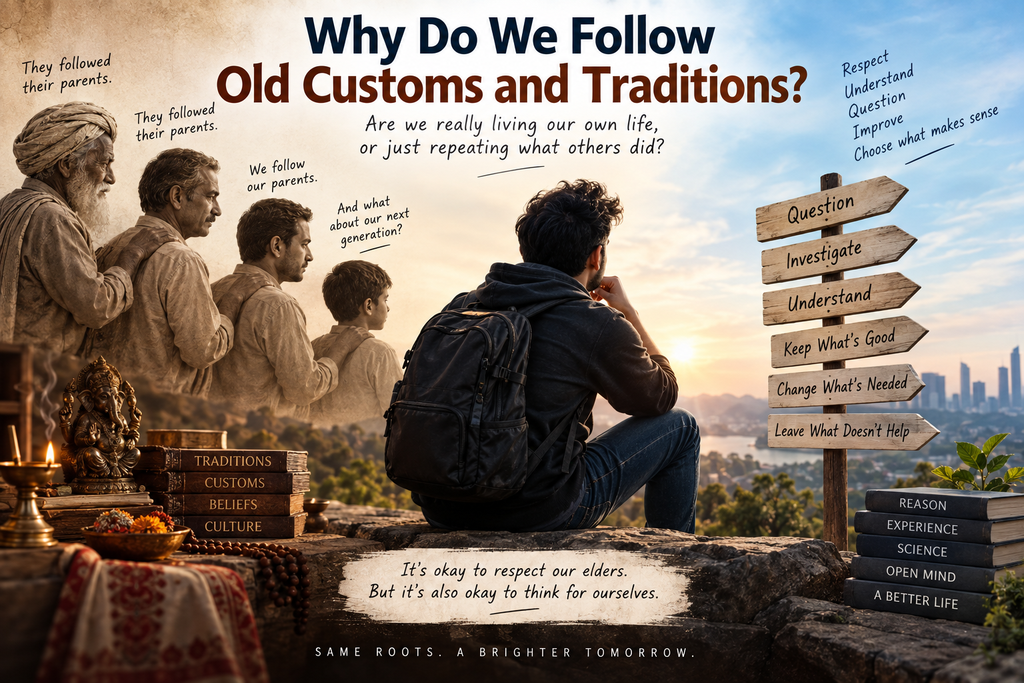
Have you ever stopped and asked yourself why you do certain things?
Why do we follow a particular tradition?
Why do we celebrate something in a certain way?
Why do we believe something is right or wrong?
Why do we follow a custom that has been followed for generations?
Many times, the answer is surprisingly simple:
“Because our parents did it.”
And our parents probably did it because their parents did it.
This means that sometimes we are not really choosing these things ourselves. We are simply continuing a chain that started generations ago.
Are We Really Living Our Own Life?
I sometimes think about this.
We like to believe that we are independent people who make our own decisions. But when it comes to traditions, beliefs, customs and even some everyday habits, we often just copy what we have seen since childhood.
Our parents followed it.
Their parents followed it.
So we follow it too.
But how often do we stop and ask:
“Does this still make sense today?”
Something being followed for hundreds of years does not automatically make it correct.
It only proves that it survived for hundreds of years.
There is an important difference between something being old and something being right.
If a thought or tradition has existed for a very long time, it may contain wisdom. But it may also contain things that were useful in a completely different time and are no longer necessary today.
We Should Not Make Every Tradition an Emotional Topic
Whenever someone questions an old custom, the discussion can quickly become emotional.
People may say:
“These are our roots.”
“Our elders followed this.”
“This is our culture.”
“We should respect our traditions.”
I agree that our elders and culture deserve respect.
But I don’t think respect means that we must accept everything without questioning it.
We can respect the person who gave us an idea while still questioning the idea itself.
In fact, I think that is one of the best ways to respect the knowledge passed down to us.
We can look at it, understand why it existed, and then decide whether it still makes sense.
Even Our Religion Is Often Decided Before We Understand It
Religion is probably one of the biggest examples.
When we are born, we don’t know who God is.
A newborn baby doesn’t know whether God exists, which religion is correct, or what any religious belief means.
We learn these things from our family and society.
If I had been born into a different family, in a different country, with a different religious background, I might have grown up believing something completely different.
That makes me think:
How much of what we believe is actually our own conclusion, and how much was simply given to us before we were old enough to question it?
This doesn’t mean that what our parents taught us is wrong.
It simply means that we should eventually examine it ourselves.
If we only believe something because our elders told us to believe it, can we really say that we have reached our own conclusion?
Our Brain Also Likes Familiar Things
There is another interesting reason why traditions continue.
Our minds naturally find familiar things easier to accept.
When we have seen something repeatedly since childhood, it feels normal.
We don’t have to think much about it.
We already know what to do, how to do it and what others expect from us.
But something unfamiliar requires effort.
We have to question it.
We have to learn something new.
We may even have to disagree with people around us.
That can be uncomfortable.
So sometimes we continue doing something not because we have carefully decided that it is the best option, but simply because it is familiar.
Old Does Not Always Mean Wrong Either
At the same time, I don’t think we should go to the opposite extreme and reject every old tradition just because it is old.
Some traditions have real value.
Some bring families together.
Some preserve history and culture.
Some teach useful values.
Some may have practical reasons behind them that we don’t understand anymore.
The point is not to reject everything.
The point is to investigate before accepting or rejecting something.
Ask why it started.
Ask what purpose it served.
Ask whether that purpose still exists.
Ask whether there is a better way to achieve the same thing today.
And then make your own decision.
We Should Be Able to Upgrade Our Traditions
I think traditions should be allowed to evolve.
The world changes.
Our technology changes.
Our lifestyle changes.
Our understanding of health changes.
Our knowledge about science changes.
Our social environment changes.
So why should every tradition remain exactly the same forever?
Maybe a tradition was useful 200 years ago but only needs a small change today.
Maybe another tradition no longer has any practical purpose.
And maybe some traditions are still completely relevant and worth preserving.
We should be able to separate these things instead of putting everything into one category.
Keep what is valuable.
Change what needs improvement.
Leave what is no longer useful.
Respecting Elders Does Not Mean Copying Them
Questioning something our elders taught us doesn’t mean we don’t respect them.
Our parents and grandparents made decisions according to the knowledge, circumstances and world they lived in.
We are living in a different world.
They may have had reasons for doing certain things that made perfect sense at that time.
Our responsibility is not necessarily to copy their exact decisions.
Maybe our responsibility is to understand what they were trying to achieve and find the best way to do it in our own time.
That, to me, is a better way of carrying something forward.
Are We Living Our Own Life?
I don’t think anyone can completely escape the influence of family, society and culture.
And I don’t think we need to.
But we should at least be aware of that influence.
If almost every important belief in our life came from someone else, perhaps we should occasionally stop and ask ourselves what we actually think.
Not just about religion or traditions, but about relationships, career, lifestyle, success, money, society and almost everything else.
Because there is a difference between inheriting a belief and understanding a belief.
And there is also a difference between blindly following a tradition and consciously choosing to continue it.
For me, investigation and cross-checking are not signs of disrespect.
They are simply a way of making life a little more thoughtful and removing things we no longer need.
Something being followed for generations doesn’t make it automatically correct. It may simply mean that generations never stopped to question it.
And maybe sometimes the most respectful thing we can do with an old idea is not blindly follow it, but understand it, question it and decide for ourselves whether it deserves to continue.