People sometimes ask me:
“Why are you atheist?”
And another question I often hear is:
“What happened in someone’s life that they lost faith in God?”
Many people assume that an atheist must have gone through something terrible, become depressed, lost someone they loved, or become angry with God.
But I don’t think it is always that complicated.
I actually look at it in a much simpler way.
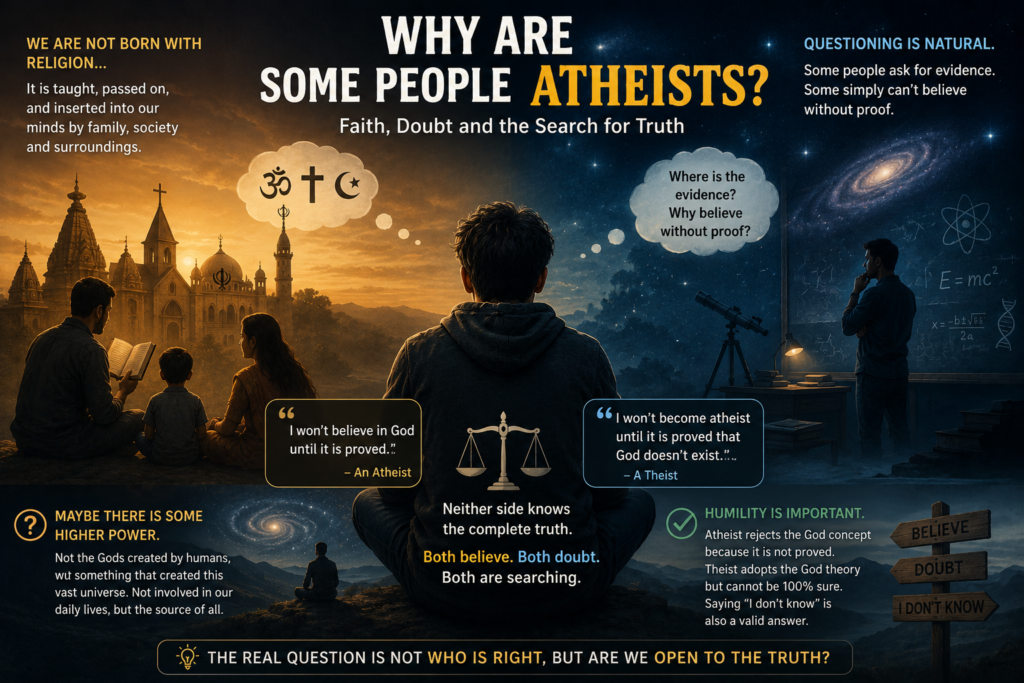
A child is not born knowing about Hinduism, Islam, Christianity, Sikhism, Buddhism or any other religion.
A newborn doesn’t know who God is.
Then, as the child grows up, the family, society and surroundings introduce religion.
They tell the child about God, prayers, religious stories, traditions and what they believe is right or wrong.
The child slowly accepts these ideas because these are the people they trust.
If the same child had been born into a completely different family and society, they might have been introduced to a completely different religion.
This makes me wonder:
How much of our religious belief is actually our own conclusion, and how much did we simply learn while growing up?
Of course, this doesn’t mean every person will continue believing what they were taught.
Some people start questioning it.
They ask:
Where is the evidence?
Why should I believe something without proof?
And eventually, they may become atheist.
But even here, there is an interesting argument from the other side.
An atheist may say:
“I won’t believe in God until there is enough evidence to believe that God exists.”
A theist may say:
“I won’t become atheist until someone proves that God doesn’t exist.”
Both statements sound reasonable from their own point of view.
And this is where I think we should be honest.
Neither side really knows the complete truth.
An atheist cannot prove with absolute certainty that no form of God or higher power exists.
At the same time, a theist cannot scientifically prove that their concept of God definitely exists.
This doesn’t mean both positions are identical. The reasoning and evidence people use can be very different.
But when it comes to something as big as the existence of God, I think we should be careful about saying:
“I know 100% that I am right.”
There is also another group of people that I find interesting.
Some people don’t believe in the Gods described by human religions, but they still believe that there may be some kind of higher power or intelligence that created the universe.
They don’t necessarily believe that this power watches every person’s daily life, answers prayers or decides what happens to individual humans.
Their belief is more like:
“Maybe something created this universe, but I don’t know what it is.”
And honestly, I think saying “I don’t know” is also a perfectly valid position.
Because the universe is enormous, and our understanding of it is still extremely limited.
For me, atheism isn’t necessarily about hating religion or being against religious people.
I respect people who have faith.
Just because I don’t believe something doesn’t mean I need to insult someone who does.
And I also think religious people should be free to question their own beliefs without feeling that questioning itself is wrong.
Maybe the most important thing is not whether someone is atheist or theist.
Maybe it is whether we are willing to say:
“This is what I believe, but I could be wrong.”
Because when we accept that possibility, we become much more open to learning.
And perhaps that’s where the real search for truth begins.
Read More Posts