Have you ever woken up after a strange dream and thought:
“What was that? Why was my brain showing me this?”
Sometimes our dreams make absolutely no sense.
You may see your school friend, your office, your childhood home and some completely unknown place in the same dream. Someone who has been gone from your life for years suddenly appears. You may even do something in a dream that you would never do in real life.
So I started wondering:
Are dreams completely random, or does our brain actually follow some pattern?
The interesting thing is that dreams are not simply random movies playing inside our heads.
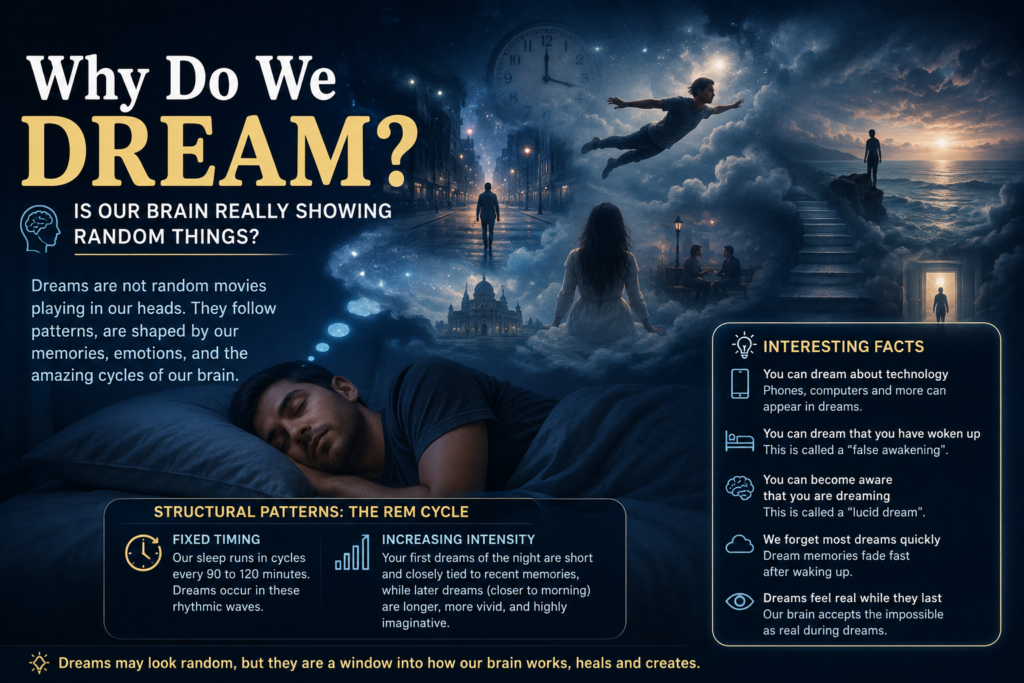
Our brain goes through different stages while we sleep, and dreaming can happen during different stages of sleep. However, the most vivid and bizarre dreams are particularly common during REM sleep.
The REM Cycle and How Dreams Change During the Night
Our sleep follows repeating cycles, generally lasting around 90 to 120 minutes. As the night progresses, the REM periods usually become longer.
This is one reason why dreams closer to morning can feel very different from those earlier in the night.
The first dreams of the night can be shorter and more closely connected with recent experiences, while later REM dreams tend to become longer, more visual, emotional, complex and imaginative. Researchers have found that later-night REM dreams are particularly rich in complex narratives and unusual experiences.
So when you wake up in the morning and remember a very long and strange dream, there is actually a reason why it may have felt so vivid.
But what about the story inside the dream?
This is where things become even more interesting.
Our brain can mix memories, emotions, recent experiences and imagination into one strange story.
For example, if you are worried about an important deadline, your dream doesn’t necessarily show you sitting in front of your laptop worrying about it.
Your brain might create a completely different situation.
You might be running somewhere.
Someone might be chasing you.
You might be late for something.
The situation looks completely unrelated, but the feeling of pressure can still be there.
That’s what makes dreams so fascinating.
The story can be strange, but the emotion can feel very real.
Our memories also seem to provide some of the building blocks for imagination. Researchers studying memory and imagination suggest that experiences and memories can be reorganized during sleep, creating new associations between things we already know.
Some Interesting Things About Dreams
There are a few things about dreams that I find especially fascinating.
We can dream about technology.
There is a popular idea that people don’t see smartphones or computers in their dreams.
That’s actually not true.
People can dream about phones, computers, social media and other modern technology. What is interesting is that these things may not always behave normally in dreams. You may try to call someone and the phone doesn’t work properly, or you may see a message that changes completely.
Dreams don’t always follow the rules of our waking world.
You can dream that you have woken up.
This one is really strange.
You may dream that your alarm rang, you got out of bed, checked your phone and started your morning.
Then you actually wake up…
and realize that the entire morning happened inside your dream.
This experience is known as a false awakening.
You can become aware that you are dreaming.
This is called a lucid dream.
In a lucid dream, you realize that you are dreaming while the dream is still happening. Some people can even influence parts of what happens next.
We don’t dream only once during the night.
Because we move through several sleep cycles, we can have multiple periods of dreaming during the night.
And because REM periods generally become longer toward morning, dreams remembered from the early morning can be particularly vivid and detailed.
We forget many dreams very quickly.
This is probably one of the strangest things about dreaming.
You can have an incredibly detailed dream and feel that you will remember every part of it.
Then you brush your teeth, check your phone, talk to someone…
and suddenly most of the dream is gone.
That’s why sometimes you wake up knowing that you had an amazing dream, but within a few minutes you can’t remember what actually happened.
I also find it interesting that we sometimes dream about people we haven’t thought about for years.
Maybe that person isn’t important to our current life at all.
So why did our brain suddenly bring them back?
Perhaps our brain doesn’t store memories like a neatly organized photo gallery where we choose exactly what to open.
During sleep, different memories and pieces of information can become connected in ways that we don’t consciously control.
Research suggests that memories from both recent and distant experiences can become components of dreams, while dreaming may also create new associations between them.
And sometimes the result is a dream that feels completely bizarre.
There is another strange thing about dreams.
While dreaming, we usually accept whatever is happening.
If someone suddenly starts flying, we don’t always stop and think:
“Wait, humans can’t fly.”
We simply accept it.
The dream feels real until we wake up.
And then, within seconds, we realize how strange the whole thing was.
It makes me wonder how much of our reality is actually controlled by the brain’s interpretation.
When we are awake, we have logic, external information and our senses constantly correcting us.
During some stages of dreaming, especially REM sleep, brain systems involved in logical reasoning and executive control work differently. At the same time, emotional brain systems become more active.
Maybe that’s one reason dreams can feel so emotional while making absolutely no logical sense.
I don’t think every dream has a hidden meaning.
Sometimes a dream may simply be the brain processing memories, emotions and experiences while we sleep.
And we still don’t have one complete scientific explanation for exactly why humans dream.
But I do think dreams show us something fascinating:
Our brain never really stops working.
Even when we are lying in bed doing absolutely nothing, our brain is still processing information, memories, emotions and experiences.
And sometimes, it creates a completely different world and lets us live inside it for a few minutes.
We wake up and think:
“That was just a dream.”
But perhaps the more interesting question is:
How did our brain create an entire world while we were sleeping?
That, to me, is much more fascinating than trying to find a hidden meaning in every dream.